Currents of commerce
By Disha Jain & Tanvi Abhyankar

Most of us encounter world trade only at the final mile - the shelf at a convenience store or the delivery agent at our doorstep. The “how” of trade happens further from land. In a highly digitalized world, it is easy to forget that the world economy depends on ocean networks. About 80-90% of the world’s trade volume moves through the sea which makes shipping the world’s most vital vascular system. Naturally, the maritime routes are the world’s arteries that drive economic growth and international interdependence, which, if clogged, would bring everything to halt at an instant.
Much before the idea of international commerce existed, sea routes were the highways of global exchanges. Coastlines were viewed as entry points to a bigger world and were not just boundaries. The very first maritime routes emerged through observation - long before engines, trade was a dance with the elements such as the currents, winds, stars, and seasons. Ancient mariners had mastered the monsoon winds of the Indian Ocean and constructed the Maritime Silk Road that facilitated the trade of Indian spices and the Chinese silk around the 2nd century BCE. Trade was slow, seasonal, and governed by the Earth’s breath. Humanity, thus, has been a seafaring species since the beginning.
Tidal history
Some of the world’s earliest trade systems developed around water, circa 3300-1300 BCE. One of the first exchanges occurred between the Indus Valley Civilization and Mesopotamia and archaeological evidence suggests goods like Harappan seals, beads, and pottery were shipped across the Arabian Sea. This movement is reflective of an organized distant maritime logistics characterized by specialized dockyards and common marina facilities.
In the Mediterranean, maritime trade roots date back to ancient Phoenician shipmen which were carried out under Roman and Greek influence. It facilitated the exchange of nearly everything from wine and grains to luxury goods and stood as a hub of cultural and economic exchange between the Asian, European, and the African continents. However, the multi-civilizational web of the Indian Ocean was possibly the most expansive medieval maritime network. Before the Europeans gained access to the Indian Ocean, Arabia, South and Southeast Asian, East Africa, and even China linked ports and sailors. Austronesians were one of the early seafarers voyaging via modern vessels. Varied exchange of spices, metals, timber, textiles, and shells designed divergent economic flows much before formal globalization.
At its core, sea trade offers unmatched economies of scale. Large vessels can carry thousands of containers or millions of barrels of oil in a single voyage, dramatically lowering the cost per unit of transport. This makes maritime shipping indispensable for bulk commodities such as crude oil, LNG, coal, iron ore, grains, and fertilizers which underpin industrial production, energy security, and food systems across the world. Even for manufactured products, shipping remains the most cost-effective option for long-distance trade, enabling firms to fragment production across countries while keeping logistics costs manageable. Sea trade also benefits from the natural connectivity of oceans. Unlike roads or railways, maritime routes do not require continuous physical infrastructure across borders. Once ports and vessels are in place, oceans provide open corridors that link multiple markets simultaneously. This flexibility allows trade routes to adapt more easily to changing demand patterns, geopolitical conditions, or supply chain disruptions. Another crucial advantage is that shipping consumes significantly less fuel than air or road transport. This efficiency has become increasingly important as economies confront carbon constraints and rising fuel costs. While shipping is under pressure to decarbonize, its underlying energy efficiency ensures that it will continue to be central to global trade even in a low-carbon transition.
Small routes but massive consequences
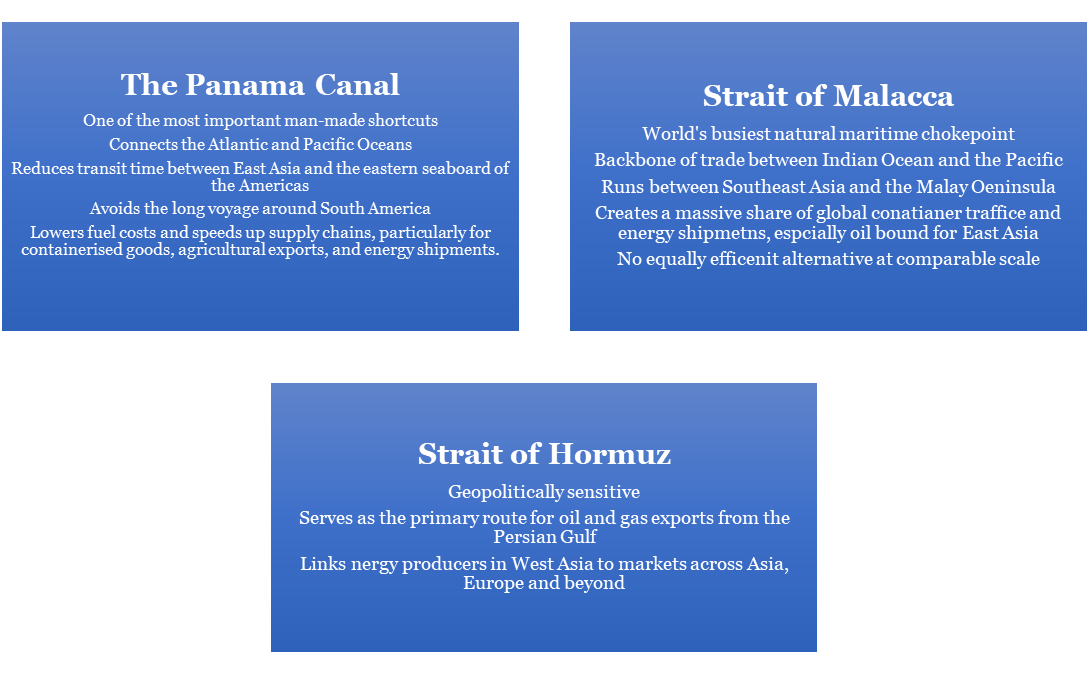
Maritime chokepoints are strategic sea routes where global shipping traffic is forced to pass through extremely narrow or constrained waterways. Despite the vastness of the world’s oceans, geography, coastlines and man-made canals funnel ships into these tight corridors, making them unavoidable for international trade. They are called “chokepoints” because any blockage whether due to conflict, accidents, piracy or geopolitical tensions can effectively “choke” the flow of goods across continents.
These chokepoints matter because they carry a disproportionate share of global commerce. Nearly 90% of world trade by volume moves by sea and a significant portion of it passes through a handful of such narrow passages. When a chokepoint is disrupted, ships are forced to reroute over longer distances, increasing costs, delaying deliveries and triggering supply chain bottlenecks. The impact ripples far beyond shipping, affecting energy prices, food security, industrial production and financial markets.
What makes maritime chokepoints uniquely powerful is the scale of their influence relative to their size. A single closure or restriction can send shockwaves through the global economy, as seen in past incidents where temporary blockages led to billions of dollars in losses within days. In an era of tightly interlinked supply chains and just-in-time logistics, these narrow sea lanes have become pressure points of the global trading system-small on the map, but immense in strategic and economic significance.
The Ever Given became stuck in the Suez Canal in March 2021 due to a mix of harsh weather, its massive size, and the narrowness of the canal. The ship was travelling through a single-lane section of the canal during a sandstorm, which reduced visibility and brought strong sideways winds. Because the vessel was extremely large and stacked high with containers, the wind pushed it off course.
As the ship drifted toward the edge of the canal, the limited space and shallow water made it harder to correct its direction. Instead of straightening out, the front of the ship hit the canal’s sandy bank, while the rear swung toward the opposite side. Within moments, the vessel turned diagonally and became firmly wedged across the canal, completely blocking the waterway.
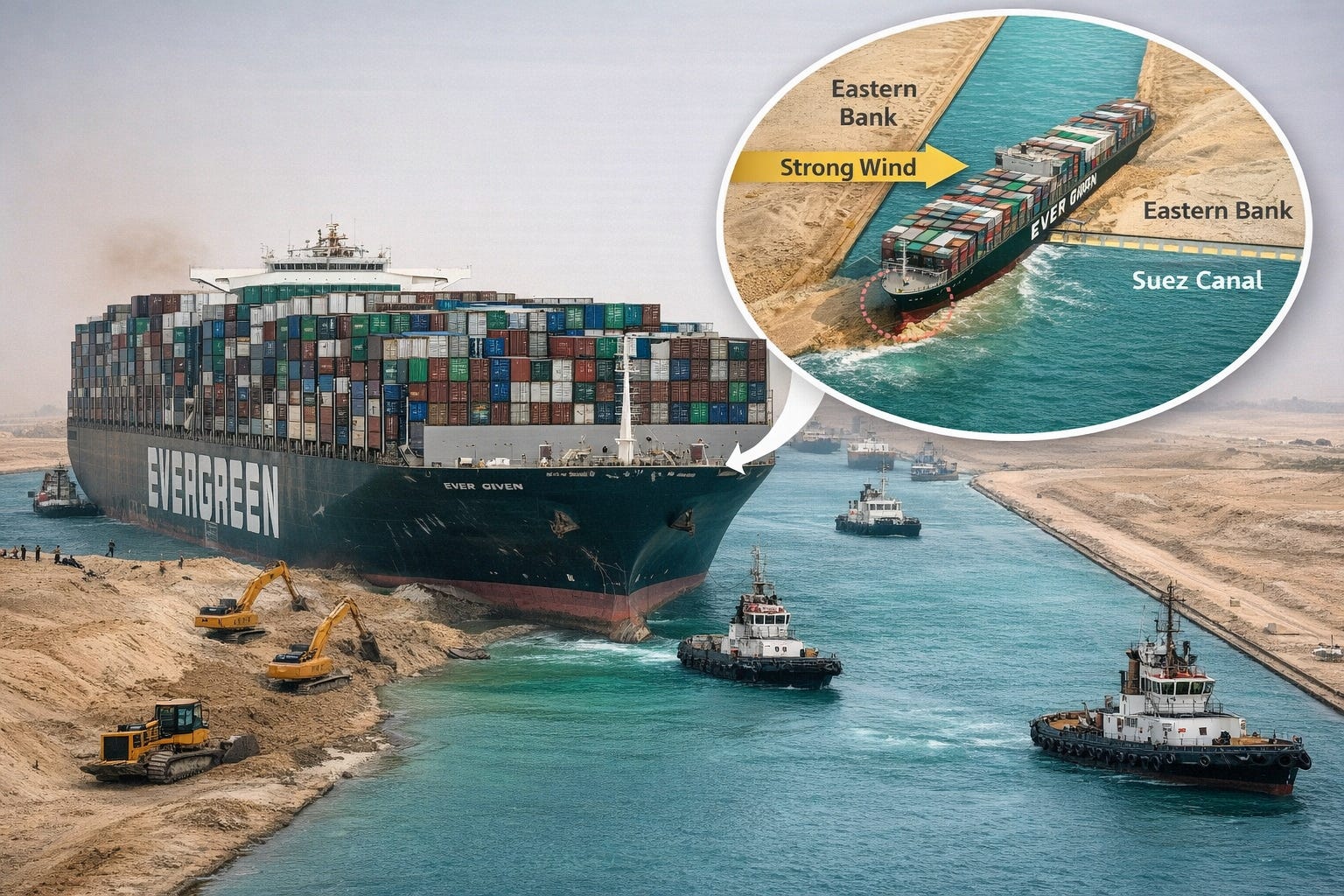
Freeing the ship was far more complicated than simply pulling it loose. Its enormous weight, combined with the way it was embedded in the canal’s banks, meant it was effectively stuck in place. Authorities had to dig away large amounts of sand, use multiple tugboats to apply steady force, and wait for high tide to slightly raise the water level. Only then could the ship be slowly realigned and moved.
When crime hijacks global trade
Piracy is often imagined as a relic of the past, but it remains a serious threat in some of the world’s busiest sea routes. Modern pirates target slow-moving commercial ships, especially near narrow chokepoints where vessels have limited room to manoeuvre. One of the most striking examples was the surge of Somali piracy in the late 2000s, when armed groups operating from the Horn of Africa hijacked cargo ships, oil tankers, and even luxury yachts near the Bab el-Mandeb Strait. At its peak, ships were seized hundreds of miles from shore, crews were held hostage for months, and ransoms running into millions of dollars became common. The threat became so severe that shipping companies rerouted vessels, armed guards were deployed on board, and international naval patrols were launched to protect trade.
The Panama Canal drought: Climate as a disruptor
Unlike sudden accidents or conflicts, climate change has emerged as a slow but powerful disruptor of chokepoints. Severe drought conditions in recent years reduced water levels in the Panama Canal, forcing authorities to limit daily transits and impose weight restrictions on ships. This led to congestion, higher shipping costs and delays in trade between the Atlantic and Pacific, highlighting how environmental stress can quietly undermine global trade routes.
Economic ripple effects: The cost of disruption
When a major maritime route is restricted or disrupted, the economic impact extends far beyond the shipping industry. The immediate effect is a sharp rise in operational costs. Insurance premiums for vessels transiting the affected route increase almost overnight, as insurers factor in higher risks from accidents, conflict or piracy. At the same time, freight rates surge as shipping companies pass on the costs of delays, detours, and uncertainty to cargo owners.
These disruptions also force ships to take longer alternative routes, adding days or even weeks to delivery times. Longer voyages mean higher fuel consumption, crew costs and port congestion elsewhere, creating a domino effect across global logistics networks. Even when routes remain technically open, heightened risk can be enough to reduce traffic, tightening supply and pushing transport prices higher.
A clear example of this was seen during the 2021 Suez Canal blockage. As hundreds of ships were stranded, global freight rates surged and insurers raised premiums for vessels transiting the canal even after it reopened. Many ships were forced to reroute around the Cape of Good Hope, adding nearly two weeks to journeys between Asia and Europe. The longer routes increased fuel consumption, tied up vessels for longer periods and created congestion at ports worldwide.
The most damaging consequences, however, are felt in modern “just-in-time” supply chains. These systems are designed to minimize inventory and rely on precise delivery schedules to keep production lines moving. Delays at maritime chokepoints can interrupt the flow of critical inputs such as fuel, food, electronics and industrial components, forcing factories to slow down or shut temporarily. What begins as a shipping delay quickly turns into a production bottleneck.
Ultimately, these costs filter down to consumers. Higher transport and insurance costs raise the price of imported goods, from everyday groceries and clothing to fuel and electronics. In a tightly interconnected global economy, a disruption at a single maritime chokepoint can quietly but decisively increase the cost of living worldwide, turning distant shipping incidents into tangible economic pressure felt far from the sea.
The green sail
In addition to the economic effects, global trade faces a dual-load of climate change and regulatory tightening, as nautical transport enters a phase where routes matter as much as vessels. Decarbonization is no longer about cleaner fuels or better engines and is altering how, where, and when ships move across the oceans.
A clear outcome of this shift is the renewed interest in alternative maritime routes, especially the ones that vow shorter distances and lower fuel consumption. The Northern Sea Route (NSR), which spans along Russia’s Arctic coastline, has emerged as a prominent example. It is said to reduce the sailing distance between East Asia and Europe compared to traditional routes via the Suez Canal, and offers the advantage of lower emissions per voyage. Lesser nautical miles translate directly into reduced fuel burn, which makes route efficiency an increasingly central metric in shipping economics.
However, these alternative routes are not simply technical shortcuts. They are shaped by environmental uncertainty, seasonal accessibility, and geopolitical complexity. Ice conditions, limited port infrastructure, and heightened environmental risks restrict the scalability of Arctic shipping. This reveals a broader point that decarbonization is forcing trade-offs between efficiency, resilience, and risk. As a result, the hunt for alternative routes is not about replacing existing corridors, but about diversifying options in a world where carbon costs influence commercial decisions.
At the same time, the push toward “green shipping” has intensified across the industry. New emission standards coming into force today have shifted climate compliance from a long-term aspiration to an immediate operational constraint. Shipping companies are increasingly required to measure, report, and reduce their carbon intensity, with penalties tied not only to emissions levels but also to inefficiencies in fuel use. Firms that can invest in fuel-efficient fleets, advanced navigation systems, and data-driven route optimization gain a cost advantage, while older vessels and inefficient routes become liabilities.
India’s Sagarmala project
Recognizing the strategic and economic importance of the seas, India has increasingly turned its attention to the Blue Economy, an approach that views oceans not just as trade routes, but as engines of sustainable growth, connectivity and strategic influence. At the centre of this vision lies the Sagarmala Programme, launched to modernize India’s maritime infrastructure and strengthen its integration with global trade networks.
Sagarmala aims to reduce logistics costs by improving port efficiency, expanding port capacity and enhancing last-mile connectivity between ports and inland markets. By developing ports as industrial and logistics hubs, the programme seeks to shift a greater share of freight from road and rail to coastal and inland waterways, which are cheaper and more efficient.
Beyond trade efficiency, Sagarmala reflects a broader ambition. As global disruptions at maritime chokepoints expose vulnerabilities in supply chains, India’s focus on port-led development is also about preparedness. Modern ports, diversified routes and stronger coastal infrastructure help reduce dependence on congested chokepoints while positioning India as a reliable maritime partner in the Indo-Pacific.
Crucially, the programme aligns with India’s Blue Economy goals by emphasising sustainable development. It integrates port expansion with coastal community development, fisheries, tourism and renewable energy, seeking to balance economic growth with environmental protection. In doing so, Sagarmala represents not just an infrastructure initiative, but a shift in how India views the seas; as assets central to its economic security and global engagement.
India is now transitioning into “Sagarmala 2.0”, a refreshed phase focusing on shipbuilding and broader maritime infrastructure support with substantial budgetary backing aimed at unlocking investment of over INR 12 lakh crore over the next decade. New initiatives such as the Sagarmala Startup Innovation Initiative (S2I2) aim to drive innovation in green shipping, smart ports and logistics. India has also launched its first maritime-focused NBFC the Sagarmala Finance Corporation and approved substantial funds to support infrastructure growth, underlining growing financial architecture for maritime expansion.
Final wave
Despite rapid advances in technology and shifts toward regionalization, international trade relies very much on maritime geography. A small number of sea routes, canals, and straits continue to carry a excessive share of global commerce that shape supply chains, energy security, and economic stability. What has evolved is the framework within which these routes operate. Decarbonization introduced new constraints into maritime trade, forcing shipping companies to optimize routes, reduce fuel consumption, and comply with increasingly strict emissions standards. At the same time, climate risks and geopolitical tensions have exposed the fragility of these critical corridors, where disruptions can quickly spill over into global markets.
Rather than diminishing the role of sea trade, these pressures are redefining it. Maritime routes are no longer just pathways of exchange rather they are strategic assets governed by environmental limits and political realities. Understanding them is essential to understanding how globalization will function in an uncertain world.
Very good and detailed analysis of maritime industry. Got ti know many new things about this industry